

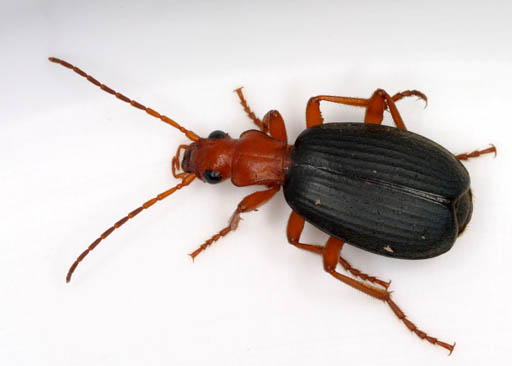
Why a Bombardier Beetle Doesn't Cook Itself
The reaction inside its abdomen hits 100°C. The beetle survives by firing it in pulses, hundreds of times a second.
In April 2015, MIT graduate student Eric Arndt aimed a synchrotron X-ray beam at a living Brachinus beetle and watched, at 2,000 frames per second, what happens when the insect fires its defensive spray. The footage settled an old question. How does an animal store hydrogen peroxide and hydroquinone inside itself, mix them with catalase and peroxidase enzymes, and fire the resulting boiling jet without becoming the casualty?
The answer is that it doesn't really fire a jet. It fires bursts. Each explosion in the inner reaction chamber pushes out one hot pulse, then the pressure wave snaps a flexible membrane shut against a valve, cutting off the flow of fresh reactants. The chamber refills, the membrane relaxes, and the next pulse fires. Arndt's team measured this happening between roughly 368 and 735 times per second, fast enough to look continuous to a frog, slow enough that the chamber walls never sit at boiling for more than a millisecond at a time.
That pulsing is what keeps the enzymes alive. Catalase and peroxidase denature above about 60°C; a continuous spray would cook the beetle's own catalysts on the second shot. The cuticular wall of the chamber, a laminate of chitin and protein, handles the pressure spikes. The brief, intermittent contact with 100°C reactants handles the heat budget.
It is a chemical engineering problem the beetle solved before there were chemical engineers.
Make Recess yours.
Sign in to save the ones you loved, never see the same thing twice, and tell us what you want more of.