

What the Lyrebird Sings During Sex
A male superb lyrebird, mid-copulation, will fake the sound of an entire panicked flock fleeing a hawk.
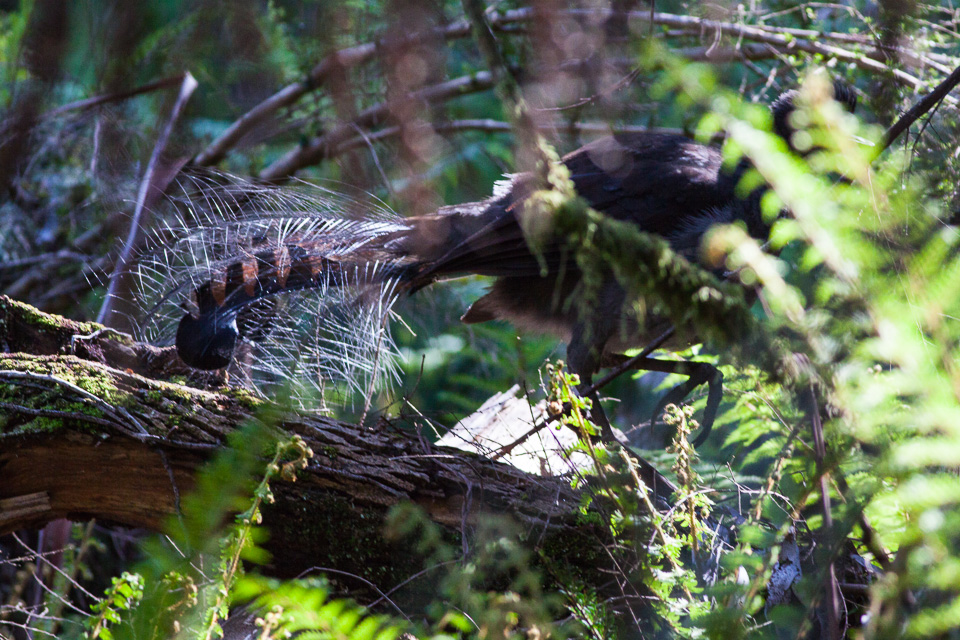
A displaying male superb lyrebird does most of the things you would expect: spreads a tail like a Victorian fan, struts on a cleared patch of dirt, mimics every other songbird in the rainforest. Then, in two specific moments — when a female tries to leave him, and during the act of mating itself — he does something very strange. He becomes a flock.
In February 2021, Anastasia Dalziell and colleagues at the Cornell Lab of Ornithology and the University of Wollongong published in Current Biology what they had been recording in the wet forests of southeastern Australia. The males weren't just imitating one alarm call. They were stitching together the calls of multiple species at once, the layered noise of a mixed-species mobbing flock — birds collectively yelling at a hidden predator. They were even mimicking the wingbeats of small birds taking off.
It is, technically, a lie. There is no hawk. The acoustic illusion appears to function as a stalling tactic: "Baby," Dalziell told a Cornell reporter, "it's dangerous out there." If a female believes a predator is close, she stays still. If she stays still long enough, copulation either begins or finishes.
This matters because most explanations for elaborate birdsong run on female preference — males evolve flashier music because females like it. Lyrebird mobbing mimicry works the other way. The female does not want to hear it. The male sings it anyway, to keep her there. The same vocal apparatus that has charmed naturalists since the species was first described in 1798 turns out, sometimes, to be a small acoustic con.
Make Recess yours.
Sign in to save the ones you loved, never see the same thing twice, and tell us what you want more of.