

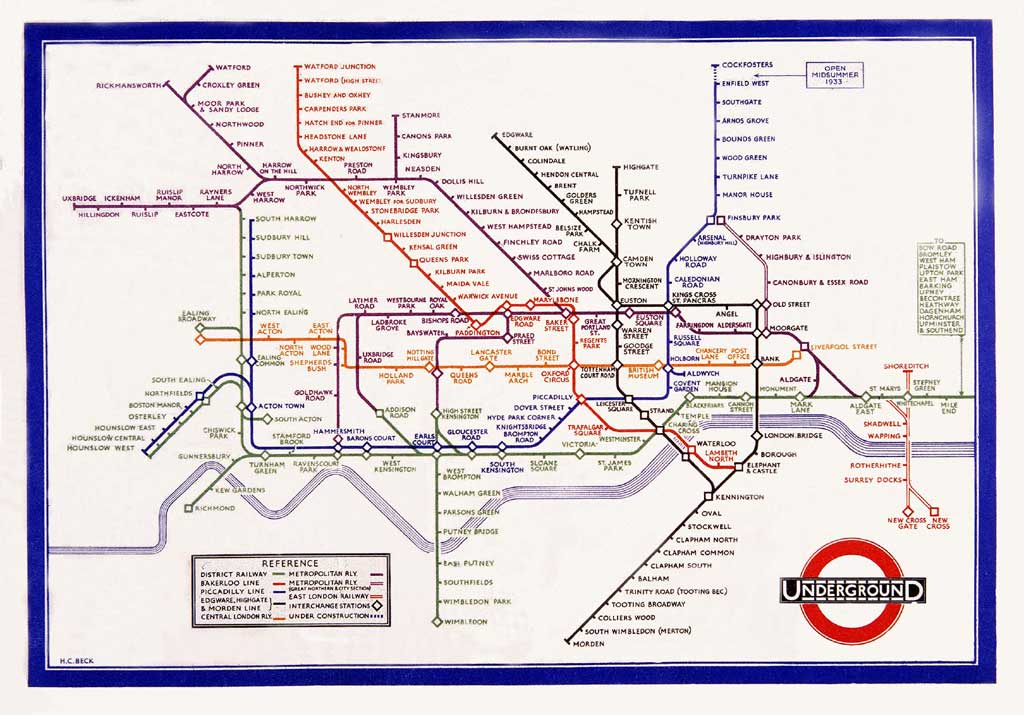
The Tube Map Was Drawn by an Out-of-Work Signalling Draftsman
Henry Beck sketched it in a notebook the year he was laid off. The Underground paid him five guineas.
In 1931 Henry Charles Beck was at home without a job. He had spent six years in the Signalling Department of Underground Electric Railways, drawing diagrams of currents and switches as horizontal and vertical strokes meeting at right angles. To pass the time he opened a notebook and sketched the Underground network using the conventions he used at work.
The geographical map of the day was a problem. It tried to honor distance, so the central stations crowded into a tangled knot while outer branches drifted off across white space no rider cared about. Beck's instinct was the engineer's: passengers underground can't see the city anyway, so geography is a courtesy you can drop. He kept the topology — which line connects to which, in what order — and threw the geometry out. Lines became colored verticals, horizontals, or 45-degree diagonals. Stations became evenly spaced ticks. The Thames stayed, a single ribbon to remind you which side of London you were on.
The Publicity Office at Frank Pick's London Transport rejected the first submission as too revolutionary. Beck revised, resubmitted, and in early 1933 the office printed about 700,000 folded pocket cards and put them out at stations. They were gone almost immediately. A second print of 100,000 followed within a month.
For the drawing Beck was paid roughly five guineas. He kept refining the map into the late 1950s and was never quite given credit in his lifetime. The line on every modern Tube map that reads This diagram is an evolution of the original design conceived in 1931 by H. C. Beck was not added until 1997.
The diagram works because Beck stopped pretending the map was about the city. It's about the journey: where you board, where you change, where you get off. The shape of London itself was clutter the signalling draftsman was already trained to delete.
Make Recess yours.
Sign in to save the ones you loved, never see the same thing twice, and tell us what you want more of.